

Using the ADAPT model, we build integrated solutions that can withstand growth, system migrations, and business changes
What is the ADAPT model?
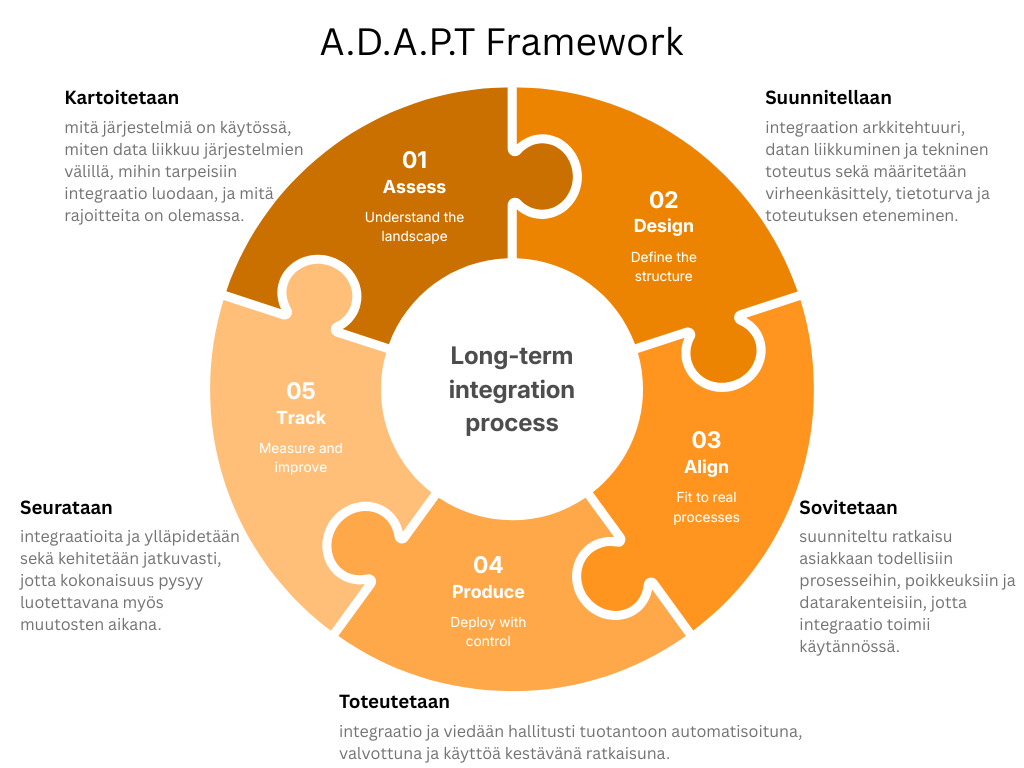
Assess. Design. Align. Produce. Track.
A.D.A.P.T is Flashnode’s project model and suite of services for companies that need customized, yet manageable and rapidly adaptable integrations. It is suitable for environments where integrations are the critical backbone of business operations and where changes must be implemented reliably and predictably.
The goal of the ADAPT model is to make integrations predictable and manageable entities that ensure the reliable flow of data between systems, reduce manual work and errors, and eliminate data silos.
ADAPT enables the continuous development and outsourcing of the integration environment through a single responsible partner, ensuring that the solution scales with the business rather than relying on individual projects or people.
We developed the ADAPT model because we observed that the biggest challenges in integration projects are not related to the implementation of individual interfaces, but rather to the long-term management of the integration as a whole.
The purpose of the ADAPT model is to describe, in a transparent and understandable way, how Flashnode carries out integrations. We wanted to conceptualize the integration service in a way that makes the operating model clear to the customer as well and highlights the principles upon which integrations are built and maintained.
With this model, integrations do not remain isolated projects or solutions dependent on specific individuals, but rather form a managed, change-resistant, and business-supporting whole throughout their entire lifecycle —regardless of individual systems or projects.

Signs That Indicate a Need for Change
The old integration doesn't work
Systems don't communicate with each other
Business is growing, and the manual approach no longer works
The big picture isn't coming together in the systems
Stages of the Service Package
ASSESS
The Assess phase is based on analysis and diagnostic models in which the current state, data flows, system roles, and risk factors are identified before technical solutions are considered. The goal is to establish a shared understanding of the business significance of integration and to define the scope of the project in a manageable way. This provides a clear and consistent picture of what should be automated, why, and how.
At this stage, we determine
- Which systems are in use
- How data flows (or does not flow) between systems
- Which systems serve as masters for different data types
- Where manual work, errors, or delays occur
- What interfaces, data transfer methods, and limitations exist
DESIGN
The goal is to create a clear and decision-making-resilient integration plan that serves as a roadmap for implementation and reduces technical and business risks.
During the design phase, we plan
- the target state and overall architecture of the integration
- data flow between systems (what, when, and how)
- the usage of interfaces and the technical model
- data models, field mappings, and conversions
- error handling and exception logic
- information security, monitoring, and access control principles
- testing and acceptance procedures
- implementation phasing and technical roadmap
ALIGN
During the Align phase, the integration plan is adapted to the customer’s actual processes, data structures, and exception scenarios. The goal is to ensure that the solution works in practice, not just on paper.
During the Align phase,
- the integration to the company’s actual business processes
- customer-specific exceptions and special situations
- differences in data models and conversion rules
- field-specific mappings and custom attributes
- pricing, VAT, payment method, and shipping logic
- Inventory and availability models
- Process boundaries and responsibilities between systems
PRODUCE
During the Produce phase, the integration is implemented and deployed according to plan so that data transfer is automated, monitored, and reliable from the moment it goes into production.
During the Produce phase,
- the technical implementation of the integration in accordance with the plan and agreements
- connections and interface integrations with production environments
- automated data transfer and scheduling
- error handling, retries, and exception handling
- logging, monitoring, and alerts
- Performance and load management
- testing in a production environment and deployment
TRACK
During the Track phase, the integration environment is continuously monitored, maintained, and developed in a production environment. The goal is to ensure that the integrations remain reliable, up-to-date, and supportive of business operations even as the environment changes.
During the Track phase,
- continuous monitoring and tracking of integrations
- identification and controlled resolution of errors
- monitoring of performance and load
- SLA-level monitoring and reporting
- identification and prioritization of change requests
- Planning new integrations and extensions
- Management of system changes and updates
What happens next when you contact us?
Who is the ADAPT service package suitable for?
ADAPT is designed for medium-sized and large companies where the system environment is already a significant part of daily business operations and integrations are no longer a secondary concern.
Typically, these are organizations that use multiple core systems, such as ERP, financial management, CRM, e-commerce, and industry-specific systems, and where data must flow reliably from one system to another without manual intervention.
ADAPT is particularly well-suited for companies:
- that already have integrations in place but have never taken the time to examine the big picture holistically
- where business is growing, expanding, or becoming more complex
- that have upcoming system changes
- where integrations are business-critical, but responsibility and visibility into the big picture are fragmented
Often, ADAPT becomes relevant precisely at the point when individual integrations are no longer sufficient to support business changes, and a clear model is needed to ensure that integrations can continue to be developed in a controlled manner going forward.
How do we operate?
RELIABLE
All solutions are based on Flashnode’s proprietary integration platform, which is centralized, monitored, and reliable; the functionality of the integrations is not tied to specific individuals or project-specific implementations. This makes the entire system predictable and reliable, even in the long term. With this model, integrations do not remain isolated projects or solutions dependent on specific individuals, but rather form a managed, change-resistant, and business-supporting whole throughout their entire lifecycle —regardless of individual systems or projects.
A PLANNED ENTITY
Integrations are not one-time projects, but a living system that is monitored, developed, and expanded alongside the business. Thanks to a ready-made and tested architecture, solutions can withstand changes—even when personnel or systems change—and the integration environment does not collapse due to individual dependencies.
A LONG-TERM INTEGRATION PARTNER
The customer gains a reliable integration partner through whom all current and future integrations can be centralized under one roof as the company grows. The solutions are fully customizable to the client’s business needs and are also compatible with legacy systems and those with limited interfaces. At the same time, ADAPT offers a cost-effective and agile alternative to cumbersome and slow integration models, where change and development proceed in a bureaucratic manner.
-1.png?width=1080&height=1350&name=Flashnode%20instagram%20(2)-1.png)

What does this mean for you?
A MORE WORRY-FREE FUTURE
When Flashnode handles your integrations, you get a predictable and controlled solution that can withstand growth, system migrations, and changes without any surprises that slow down your business. Integrations won’t break down as volumes increase or systems change; instead, changes can be made in a controlled and phased manner, with less risk and without constant rebuilding.
SUPPORTING GROWTH
When systems work seamlessly together, manual work and the resulting extra costs are significantly reduced. Time isn’t wasted on constantly fixing errors or resolving exceptions; instead, efforts can be focused on business development and growth. Integrations support moving forward—not patching up problems from the past.
FREE YOURSELF FROM THE TECHNICAL MAZE
Integrations can be safely outsourced without relying on specific individuals or vendors. Flashnode ensures that the underlying infrastructure operates reliably and in a controlled manner. If you don’t want to spend your time thinking about technical solutions but rather focus on matters that drive business growth, it makes sense to entrust your integrations to an experienced partner.
Project Progress
Assessment
We’ll assess how your company can get the most out of integration.
Design
We plan the implementation and ensure that it is feasible, taking into account the limitations of the software.
Implementation
We integrate the software as agreed and ensure seamless data transfer.
Usage
We make sure everything runs smoothly. We’re also always available if you have any questions.
"Integrating Flashnode not only solved our challenges but also exceeded our expectations—our processes are now faster, more accurate, and clearer than ever before."

Specializes exclusively in integrations
Atrusted partner to over 300 long-term clients
Over 10 years of experience in the field

The entire service journey in one package
Agile yet stable —big enough to serve, small enough to respond quickly
An independent platform that operates independently of any specific system or technology
We integrate the following software programs, among others
Enterprise
Enterprise is designed for companies that handle large volumes of data transfers between different systems or manage a significant amount of customer-specific data.
-
Secure Data Transfer
-
Comprehensive Custom Integration Solution
-
Implementation under the guidance of an expert
-
Dedicated server environment
-
Flashnode Support
-
Credit/Refund Integration
-
Paytrail Integration
-
Order Integrations
-
Product Data Integration
-
Inventory Balance Integrations

-1.png?width=560&height=700&name=Flashnode%20instagram%20(2)-1.png)
Calculate the benefits of automation in replacing manual work
With our calculator, you can estimate how much time and money your company can save by automating repetitive processes.
Did you need further clarification?
How does integration work in practice?
Flashnode’s integrations allow you to connect the systems you’re already familiar with, enabling them to work together seamlessly. The specific data that is transferred from one software application to another depends on the software your company uses and your company’s needs. Send us a message, and we’ll work with you to determine the best solution for your business.
Is ADAPT a new service or a way to implement integrations?
ADAPT is Flashnode’s approach to implementing and managing integrations. It clearly describes how integrations are designed, built, and managed throughout their entire lifecycle. Based on this operating model, we have named the integration suite delivered as a service “ADAPT”—to reflect integration projects implemented in accordance with the model.
How much does the ADAPT service package cost?
The price depends on the scope of the project and the number of systems. For example, basic solutions start at around 99 euros per month. Request a quote, and we’ll provide you with a detailed proposal and cost estimate. Or download the price list here.
Does ADAPT work if you're using legacy systems?
Yes. ADAPT is always designed to fit a company’s actual environment. The service takes into account existing systems, various data transfer methods, and technical constraints, and integrates them into a cohesive whole rather than leaving them as isolated or project-specific solutions. If a system change is necessary, we offer support in selecting the right solution and build integrations to serve your business needs even after the change.
How do I know which systems we can integrate?
You can easily check which systems we can connect to each other using App Selector. Select the systems you use, and you’ll immediately see which integrations are available and how data flow can be automated. If you don’t see your system on the list, please contact us—we’ll explore the possibilities with you.
What does the customer need to do to implement ADAPT?
Successful integration requires the customer to provide a description of key business processes and an understanding of how and for what purposes the data is used. In addition, access to the necessary systems within the agreed scope and designated points of contact are required. The customer’s involvement focuses primarily on the initial definition and approval phases, while technical implementation and ongoing management are the responsibility of Flashnode.